Context
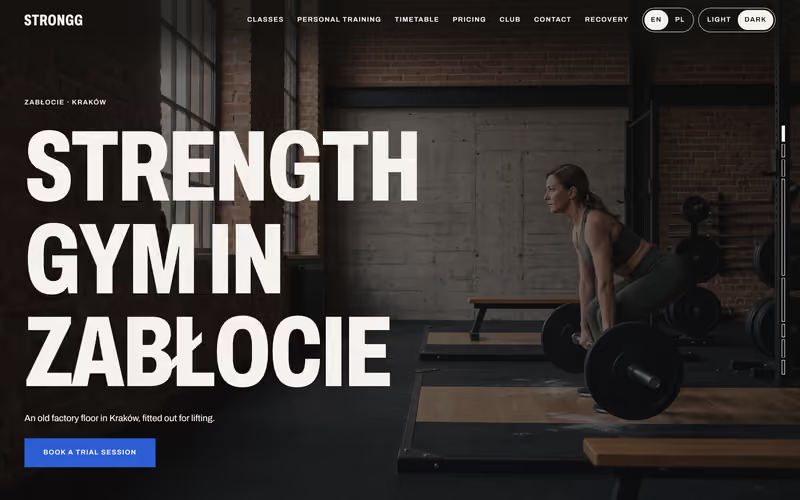
High-end gyms sell the room and the coach, not the membership card. I wanted to see what that website looks like for a club that never holds more than sixty people on the floor. STRONGG is a brand invented for this portfolio: the club in Kraków's Zabłocie district does not exist and the photographs of the hall are generated. The footer of every page says so.
What I did
Twenty-three pages in each language, Polish and English, with translated addresses. The home page, the club and its five zones, six kinds of class, each with a page of its own, a week's timetable with filters and the number of places left beside every hour, pricing, personal training, the trial session, recovery, questions, a journal with four entries, contact and the legal pages. Two forms, the trial booking and the message to the club, behave like real ones: they check what you type and confirm what you sent, but nothing leaves the browser, because there is nowhere to send it. A light and a dark theme switch in the header.
Decisions
The guiding idea is the set. The home page runs in numbered sections, the five zones of the hall move past one at a time in a single full-screen window, and the club's numbers, the square metres, the opening hours and how many people fit, count up to their value instead of just sitting there. Anyone who would rather skip the zone series has a link above it that does exactly that.
Dark photographs of the hall, large condensed capitals in the headings and one blue accent, used on buttons and nowhere else. The site sets no cookies and collects no data, so instead of a consent banner there is one sentence saying that, and a “Got it” button.